


When it comes to living soil, many immediately focus on the ingredients: worm castings, compost, perlite, maybe a few organic additives – and the mix is ready.
But this is precisely where the real problem lies.
Because the question is not first what you mix into your soil, but what for you mix it.
A 25-liter pot functions fundamentally differently from a permanent bed – and that precisely determines whether your soil will actually work later or not.
Why there's no "one true living soil mix"
Living soil is often treated like a fixed recipe. In practice, however, it's a system composed of three factors:
-
Structure (air & water balance)
-
Organic Matter (nutrient source)
-
Microbiology (conversion & availability)
These three areas are interconnected. As soon as one of them doesn't fit, the entire system collapses.
What is often overlooked:
The weighting of these factors is not always the same.
A small volume requires different solutions than a large one. A system that is restarted after one cycle works differently from soil that is intended to remain stable for years.
Therefore, the most important decision is always: pot or bed?
Pot vs. Bed: The Decisive Difference in Setup
"A pot is not a bed – and forgives fewer mistakes."
Working in a pot (25–30L)
A fabric pot of this size is a controlled but limited system.
You have little buffer, fast processes, and hardly any long-term stability.
Specifically, this means:
-
Nutrients must become available within one cycle
-
the structure must remain consistently loose
-
soil life needs active support
And very important:
A 25–30L pot is not a true living soil system.
It is an organic grow with living components, but not a stable, self-sustaining soil.
Working in a bed (no-till)
A bed or large soil volume behaves completely differently.
Over time, a self-regulating system develops here:
-
organic matter is continuously broken down
-
microorganisms and fungi form stable networks
-
nutrients are created in a cycle
The crucial difference:
The soil is no longer replaced, but maintained.
This is the point where one can truly speak of living soil.
The setup doesn't start with nutrients, but with structure
Before talking about fertilizers or ingredients, the foundation must be right: the structure.
A functioning living soil is always:
-
loose, but not dry
-
moist, but not compacted
-
stable, but not compact
Especially in a pot, the structure determines whether your grow succeeds or not.
Typical structural components in a pot:
-
Perlite or pumice (approx. 10–20%)
-
loose basic soil
-
optional coco coir for water retention
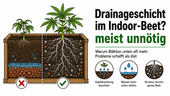
If the soil becomes too dense, oxygen is lacking – and with it, the entire soil life collapses.
In a bed, this focus shifts somewhat. Here, it's less about "artificial loosening" and more about natural buildup.
Typical structural agents in a bed:
-
coarse compost
-
plant residues and root material
-
smaller pieces of wood or coarse organic matter
These particularly promote fungal structures and ensure stable soil in the long term.
Organic Nutrients: The Biggest Misconception in Practice
A deficiency is often a problem of availability
Many growers simply mix everything they can find into their soil.
This rarely leads to a better result.
The crucial point is the availability of nutrients.
Fast and slow-release nutrients – the crucial difference in the system
A functioning living soil system depends significantly on how quickly nutrients become available in the soil. This is precisely one of the biggest differences between a pot setup and a permanent bed.
At its core, it's always about the question:
How long does it take for a substance to be converted into a plant-available form by microorganisms?
Fast-release components (ideal for pot systems)
In a pot, you work with a limited volume and a clearly defined timeframe.
This means that the nutrients used must be able to be metabolized within a few weeks.
The basis here is always materials that are already active or decompose very quickly:
Central Basis:
-
Worm castings – provide directly available nutrients, enzymes, and an active microbiome
-
Mature, active compost – brings diversity to soil life and short-term nutrient availability
Based on this, targeted plant-based and organic components can be added:
Nitrogen (N) – fast release:
-
Alfalfa meal
-
Nettle meal
-
Clover or legume residues
-
Malt sprouts / Malt flour
Phosphorus (P) – fast to medium release:
-
Bat guano (depending on origin)
-
Chicken manure (composted)
-
Fish meal
Potassium (K) – fast release:
-
Vinasse
-
Molasses (indirectly via microbial activity)
-
Plant ferments (e.g., from comfrey)
Micronutrients & Enzymes:
-
Algae meal (Kelp)
-
Compost teas
-
Plant liquid manures
These components have two crucial advantages in a pot:
-
They are quickly metabolized and become available to the plant in a timely manner
-
They immediately activate soil life, which is extremely important in small volumes
At the same time, in a pot, care should be taken not to make the mixture too "sluggish."
Too many slow-release components often mean that although nutrients are theoretically present, practically nothing reaches the plant.
Slow-release components (ideal for beds & no-till systems)
In a bed or permanent system, the focus shifts completely.
Here, it's not about short-term availability, but about long-term stability and cycles.
Slow-release substances are broken down over weeks, months, or even years. They form the basis for a sustainable nutrient system.
Nitrogen (N) – long-term:
-
Horn meal
-
Horn meal (powdered)
-
Feather meal
-
Hair meal
Phosphorus (P) – very slow release:
-
Bone meal
-
Rock phosphate
-
Fishbone meal
Potassium (K) – long-term:
-
Wood ash (use carefully!)
-
Potassium-rich rock dusts
-
Plant residues (e.g., comfrey mulch)
Minerals & Trace Elements:
-
Rock dust
-
Basalt meal
-
Diabase meal
Structural and long-term carriers:
-
Biochar (ideally "charged")
-
Wood pieces and coarse organic matter
-
Root residues and mulch layers
These substances do not act directly but unfold their strength in interaction with microorganisms and fungi.
Especially in no-till systems, this creates a stable nutrient cycle:
-
organic material is continuously decomposed
-
nutrients are slowly released
-
soil life regulates availability itself
Practical understanding: Why the wrong choice often has no effect
A common mistake is to randomly combine both categories without considering the system.
A classic example is horn meal:
-
In a pot, they often remain almost ineffective because there isn't enough time for decomposition
-
In a bed, they are a valuable long-term nitrogen store
The same applies to many mineral components.
They only really unfold their effect when a stable microbial system is present.
The most important insight
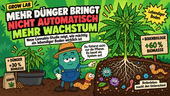
It's not about using as many ingredients as possible.
But about understanding:
When does a nutrient become available – and does that suit my system?
If this question is answered correctly, the mixture automatically becomes better – regardless of whether you are working in a pot or in a bed.
Microbiology: The actual engine behind everything
Without microorganisms, no living soil works – whether in a pot or a bed.
They take on the central task:
-
Decomposition of organic matter
-
Conversion into plant-available nutrients
-
Stabilization of the entire system
In a pot, this soil life must be actively built up and supported, because it cannot stabilize long-term.
In a bed, on the other hand, a natural balance develops over time.
This is exactly where the difference between a "living substrate" and a true living soil system becomes apparent.
Preparing the soil: Why direct planting often causes problems
A common mistake is to use freshly mixed soil immediately.
Organic components must first be broken down by microorganisms.
Without this phase, nutrient availability is often lacking – or it becomes too uncontrolled.
Therefore, it is worth preparing the soil:
-
Lightly moisten the mixture
-
Let it rest for some time
-
Start microbiological activity
In a pot, 1–2 weeks are often enough.
In larger systems, this process can take significantly longer – but it also brings more stability.
How a functioning system manifests in the grow
A well-structured soil is recognized not by the list of ingredients, but by its behavior during the grow.
Typical signs:
-
uniform, healthy growth
-
stable water retention without waterlogging
-
active, "living" soil structure
-
little need for constant re-fertilization
If these points are met, the system is working – regardless of the exact mixture used.
Conclusion: The right soil always depends on the system
The biggest mistake with living soil is the search for the perfect recipe.
In practice, it's not about combining as many ingredients as possible, but about understanding the system.
A pot is a short-term, controlled setup.
A bed is a long-term, evolving ecosystem.
And this leads to the most important realization:
Not every organic soil is living soil.
A true living soil system only begins where the soil remains permanently and can regulate itself.
Or, in other words:
In a pot, you build good soil.
In a bed, you build living soil.

Community voices
No public comment yetBe the first to share your view. Did this article help you or is something still missing?