


Cannabis is a light-driven plant. Without light, there's no growth, no structure, no yields.
And yet, a fundamental error in thinking is currently happening right here:
More and more growers are trying to control light using numbers –
PPFD, DLI, sensors, apps.
In doing so, they overlook the crucial point:
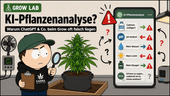
👉 The plant already shows you whether your light is right.
And more importantly:
👉 The quantity of light isn't the main problem – it's the quality of the light and how your plant reacts to it.
What Light Really Controls in Cannabis
Light doesn't just influence "growth".
It controls:
- Photosynthesis rate
- Internode spacing
- Leaf structure
- Water balance
- Flower development
More light can bring more performance –
but only if the system is stable.
👉 Water, climate, and substrate must keep up
Otherwise, more light quickly turns into more stress.
Why you don't need a light sensor
Stable grows were achieved in recent years –
long before everyone had a measuring device in their tent.
Why?
👉 Because good growers learned to read their plants.
A sensor shows you:
- how much light theoretically arrives
But not:
- whether your plant can process it
- whether your setup is homogeneous
- whether stress is occurring
👉 A measurement value does not replace observation.
Sensors are useful for:
- large setups
- reproducible processes
- targeted optimization
But they are not a must for healthy plants.
Recognizing too much light: The typical signs
Real light stress is clearly visible if you know what to look for.
Typical symptoms:
- lightened or bleached tips (bleaching)
- curled leaves ("taco" / "canoeing")
- hard, upward-stretched leaf structure
- dry leaf tips
- stagnant growth despite adequate supply
👉 Important:
Light stress is often a combination problem of:
- high intensity
- temperature
- water stress
More on light stress in the Grow Doctor
Too little light: The often underestimated mistake
Not only too much light is a problem.
Too little light manifests as:
- strong stretch
- long internodes
- unstable growth
- smaller leaves
- weak flower development
👉 The plant "searches" for light –
and loses structure in the process.
Reading leaf position correctly
Leaf position is your most important tool.
Healthy:
- slightly upright
- taut, active
Problematic:
- strongly curled
- extreme upward curvature
- hard, stressed structure
👉 Important:
"Praying Leaves" are not a signal to "give more light".
They show activity – not need.
Practice: Setting up light correctly without measuring devices
A functional approach:
- choose appropriate lamp for the area
- start moderately
- adjust distance precisely
- observe plants
- adjust gradually
👉 No hasty changes
👉 no daily readjustments
Cannabis doesn't react immediately –
but very clearly over time.
⚠️ Light Quality: The Decisive Difference
Many problems don't arise from too much or too little light.
But from:
👉 poor light quality
This is the point that many completely underestimate.
Problems with inexpensive LED systems
In the lower price segment, the following often occur:
- uneven light distribution (hotspots & shadows)
- unstable spectra
- fluctuating performance
- inefficient diodes
👉 Result:
no constant light signal for the plant
What this specifically means
The plant reacts contradictorily:
- stress at the top
- under-supply at the bottom
👉 And this is precisely where typical misinterpretations arise:
"Do I need more light?"
"Is it too much?"
👉 even though the actual problem is the light source
Why marketing can deceive you here
Many products are currently being heavily promoted through:
- influencers
- YouTube
- aggressive advertising
👉 Visibility does not replace quality.
What really matters:
- even illumination
- stable spectrum
- consistent performance
Our Clear Recommendation
If you want to save yourself problems, start here:
👉 with a solid lighting foundation
Reputable manufacturers like
SANlight
or
Lumatek
The Difference in Practice
👉 bad lamp = you search for errors
👉 good lamp = you understand the plant
Properly Classifying Advanced Lighting Setups
Modern setups come with additional tools.
But:
👉 They are fine-tuning – not the foundation.
stand for exactly this stability.
Under Canopy Lighting
Can help with:
- dense canopies
- large areas
Brings little benefit with:
- small setups
- poor plant structure
👉 Canopy management is more important than additional lights
Blue Add-lights (Increasing blue component)
Can:
- reduce stretch
- make plants more compact
But:
- modern LEDs already cover this
- the effect is limited
👉 Spectrum changes behavior – not the foundation
Conclusion: Your Grow Doesn't Need a Tech Overkill
The biggest mistake in modern growing:
👉 too much focus on technology
👉 too little focus on the plant
You need:
- a stable light source
- a functioning system
- understanding of plant reactions
You don't need:
- permanent measurements
- a number fetish
- hectical adjustments
👉 The plant is your best measuring instrument.
If you learn to read it,
your grow will become more stable, easier, and better.


Community voices
No public comment yetBe the first to share your view. Did this article help you or is something still missing?