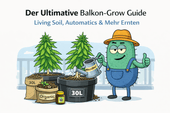
The biggest misconception in Living Soil
Most growers are looking for:
- the best soil
- the perfect fertilizer
- the optimal schedule
But they overlook the crucial factor:
It's not the soil that determines if Living Soil works – it's the volume.
The central thesis
Living Soil is not a product, but a system – and every system needs a minimum volume to function stably.
Or more clearly:
If your pot is too small, you have to fertilize no matter how "organic" your approach is.
The CannaSelection Volume Model (Basis for every setup)

This model helps you realistically classify your setup, regardless of marketing or product promises.
Under 20 Liters - not a Living Soil system
- no stable microbiology
- no buffering
- high error susceptibility
👉 Reality:
You're running an organic fertilization system - not Living Soil.
20-40 Liters - limited system
- initial biological stability
- but hardly any true self-regulation
- highly dependent on the grower
👉 Crucial sentence:
In this range, the grower decides - not the soil.
40-80 Liters - Beginning of true Living Soil dynamics
- stable microbial activity
- measurable buffering effect
- initial self-regulation
👉 From here, the system changes:
The soil starts catching mistakes - no longer just you.
80 Liters+ / Beds / No-Till - full system
- stable cycles
- resilient soil structure
- minimal intervention needed
👉 This is true Living Soil:
A system that works for you - not against you.
Why small pots slow down Living Soil
1. Unstable Microbiology
Microorganisms need:
- space
- time
- constant conditions
👉 In small pots:
The system builds up slower than it breaks down.
2. Lack of Buffer Zone
Large volumes:
- compensate for fluctuations
- store nutrients
Small volumes:
Every deviation directly affects the plant.
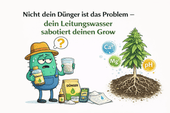
3. Water becomes a critical factor
Many growers underestimate
It's not the nutrient that's the problem - but the ratio in the irrigation water.
👉 Practical reality:
A large proportion of all supposed deficiencies arise from imbalances - not from actual deficits.
The crucial shift in perspective
Classical thinking:
Plant → needs nutrient → Input
Living Soil thinking:
Soil → regulates system → Plant is supplied
👉 And for that, it needs:
- Volume
- Stability
- Time
Practice: What your pot size really means
Under 40 Liters
- active intervention necessary
- water quality crucial
- frequent corrections
👉 Reality:
You are using Living Soil methods - but not a stable Living Soil system.
From 40 Liters
- significantly fewer interventions
- better stability
- system starts working
👉 Turning point:
Here, every action no longer immediately determines the outcome.
80 Liters and larger
- maximum stability
- long-term cycles
- minimal input
👉 Desired state:
The system sustains itself.
Find the right strategy for your pot size
👉 Use our tools to optimally categorize your setup:
👉 Or go directly to the detailed analyses:
- Understanding 20 Liter Setup
- Optimizing 30 Liter Setup
- 50 Liter Living Soil
- Mastering 80 Liter Living Soil
- No-Till & Raised Bed Systems
The most important insight
Living Soil doesn't start with the substrate - but with the volume.
And even more clearly:
Below ~40 liters, you lose the central advantages of Living Soil and operate again as in a fertilization system.
Conclusion
Living Soil is not a label - but a functioning system with clear boundaries.
If you understand these boundaries:
- you work with the soil
- instead of against it