


More nitrogen. More growth. More yield.
That is how plant nutrition is often explained. If a plant is lacking something or growth falls short of expectations, the next dose of fertilizer quickly ends up in the irrigation water.
A new cannabis study shows quite impressively why this calculation falls short.
Researchers at Wageningen University & Research investigated how cannabis responds to different amounts of nitrogen and different levels of biological diversity in the soil. They looked at more than just bacteria and fungi. The focus was on protists and nematodes, which feed on microorganisms and therefore intervene deeply in a soil’s nutrient cycle.
The result:
Greater diversity of these organisms increased plant biomass in the experiment by up to 60 percent.
More nitrogen also increased biomass. However, the effect was only up to 30 percent.
What is fascinating is not the number alone.
The study shows how important the processes between roots, microorganisms and the soil’s entire food web can be. Nutrients do not merely need to be present. They need to be processed in a functioning system and made available to the plant.
That is exactly where Living Soil begins.
What exactly did the study investigate?
The study was published on August 12, 2026, in the scientific journal Global Change Biology. The researchers studied Cannabis sativa of the “Ivory” variety.
A total of 160 plants were cultivated in a controlled greenhouse experiment. The researchers combined four nitrogen levels with four different levels of biological diversity.
For nitrogen, they simulated 0, 25, 100 and 150 kilograms of nitrogen per hectare per year.
For soil biology, the spectrum ranged from no additional predator community to combinations of 20 protist species and four nematode species. Each combination was replicated ten times. The plants then grew for 42 days.
One limitation is important to note.
This was not a classic Living Soil grow. The starting substrate consisted of sand and nutrient-poor potting soil and had previously been autoclaved. Defined communities of bacteria, fungi, protists and nematodes were then introduced.
This made the experiment controllable for research purposes. A genuine Living Soil is biologically far more complex.
That is precisely why the result is so interesting.
Even a highly simplified soil food web was able to significantly change plant development.
Up to 60 percent more biomass through greater biological diversity
First, the researchers tested what happened when protists and nematodes were added to the existing microbial system.
This addition alone significantly increased plant biomass. The authors report increases of approximately half. The effect was particularly pronounced at low and medium nitrogen levels.
It became even more interesting as diversity increased.
The more diverse the community of protists and nematodes became, the more total plant biomass increased. Compared across the diversity levels, the difference was up to 60 percent.
More nitrogen also had a positive effect.
However, the increase was only up to 30 percent.
And this is where things become interesting.
Apparently, it was not simply the amount of nitrogen in the pot that determined how strongly the plants grew.
The biological system played at least as important a role.
Nutrients in the soil are not yet plant nutrition
This is one of the points that is often misunderstood in organic cultivation.
We can analyze a soil and determine that nitrogen, phosphorus, potassium and other elements are present.
But that does not automatically tell us how much of them is actually available to the plant.
Especially in organic systems, large portions of the nutrients are initially bound in organic compounds or microbial biomass.
There is an entire biological process between “present in the pot” and “available for root uptake.”
Bacteria and fungi break down organic material.
Other organisms, in turn, feed on these microorganisms.
In the process, nutrients are released and reintroduced into the cycle.
The plant is therefore not simply positioned in front of a filled nutrient storehouse. It lives within a network that is constantly binding, transforming, releasing and taking up substances again.
Welcome to the Soil Food Web
This is exactly where the protists and nematodes from the study come into play.
Many protists feed on bacteria. The same applies to certain nematodes.
And this is anything but insignificant for the plant.
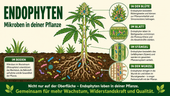
Bacteria take up nutrients and store some of them in their biomass. When these bacteria are eaten by other organisms, some of these nutrients are released again.
This cycle is often described as the Microbial Loop.
The study’s authors explain the observed growth effect partly through precisely these processes. Protists and nematodes changed the composition of the bacterial community far more strongly than the different nitrogen applications. At the same time, they influenced functions associated with carbon and nitrogen cycles.
Soil is not alive simply because a few bacteria happen to be present somewhere.
It is alive through relationships.
Bacteria.
Fungi.
Protozoa.
Nematodes.
Roots.
Organic material.
Water.
Oxygen.
Minerals.
And countless interactions between them.
That is what creates a functioning soil system.
More microorganisms does not simply mean more of the same
Another fascinating aspect of the study is biological diversity.
The researchers did not only investigate whether soil organisms were present. They deliberately increased the number of different protist and nematode species.
This had a measurable effect on plant biomass.
Why?
Different organisms occupy different ecological niches. They prefer different food sources. They respond differently to environmental conditions and, in turn, influence different parts of the microbial community.
The authors therefore refer to functional complementarity.
Put simply:
Twenty different actors can fulfill functions together that five species alone cannot fully cover.
This is a fundamental idea behind biological diversity in soil.
A stable system does not necessarily arise because a single “good” microbe is present in the greatest possible numbers.
The network is what matters.
And what did the nitrogen do?
It would now be wrong to derive the headline from the study:
Fertilizer is unnecessary.
That is explicitly not what it shows.
Nitrogen had clear effects on the plants. Higher nitrogen applications increased chlorophyll content, among other things, and influenced the nutrient levels of the plant and soil more strongly than the diversity of the soil organisms studied.
A plant needs nitrogen.
It needs phosphorus.
It needs potassium, calcium, magnesium, sulfur and numerous micronutrients.
Biology cannot conjure up elements that are missing from the system.
But it can have a decisive influence on what happens to the nutrients that are present.
And that is precisely why the question is not:
Fertilizer or soil life?
The better question is:
How well does the existing nutrient supply work together with the biological system?
Why more fertilizer eventually stops being the answer
Plant growth is always limited by several factors at the same time.
If nitrogen is genuinely lacking, additional nitrogen can increase growth.
But if sufficient nitrogen is available and another factor is limiting, adding more and more nitrogen will eventually achieve little.
Maybe phosphorus is lacking.
Maybe potassium.
Maybe oxygen in the root zone.
Maybe the water supply is not right.
Maybe the mineralization of organic components is insufficient.
Maybe the microbial system is weak.
The new study provides a strong example of precisely this.
The researchers found that additional nitrogen did affect nitrogen levels. However, this did not lead to a proportional increase in biomass.
The authors therefore also discuss phosphorus and potassium as possible additional factors. Through their feeding activity, protists and nematodes can influence not only nitrogen cycles. Other bound nutrients can also be made available again as a result.
More nutrients in the soil therefore do not automatically mean more growth.
That is exactly why we at CannaSelection think in systems
This is also why we do not see Living Soil as an alternative fertilization schedule.
Living Soil does not mean simply replacing mineral fertilizer with organic fertilizer.
The real change goes deeper.
We are not only trying to feed the plant.
We are trying to build a system in which organic matter, minerals, microorganisms and roots work together.
That is why our guiding principle is:
You do not control the plant. You control the system.
When this system functions, it can use available resources more efficiently.
That does not mean you will never need to add nutrients.
A hungry plant cannot live on biodiversity alone.
But just as little can every problem be solved with the next bottle of fertilizer.
Where MicroBio+ fits into this system
This is precisely where MicroBio+ from CannaSelection fits in.
MicroBio+ is not an NPK fertilizer.
It does not provide an additional nitrogen boost and is not intended to replace an inadequate nutrient supply.
MicroBio+ complements the microbial level of a biologically managed system with a living culture of four clearly identified microorganisms:
-
Lactobacillus plantarum
-
Lactobacillus casei
-
Rhodopseudomonas palustris
-
Saccharomyces cerevisiae
It is used in the root zone and intended for Living Soil, organic soil, Reuse Soil, biologically managed coco and Bio-Hydro.
The idea behind it aligns precisely with the basic principle also made clear by the new study:
Do not only look at what nutrients are in the pot. Also look at what happens to them biologically.
Clear differentiation is important here.
The Wageningen study did not investigate MicroBio+.
Nor do the microorganisms contained in MicroBio+ correspond to the protists and nematodes that were specifically tested in this experiment.
The study is therefore not evidence of MicroBio+’s efficacy.
It provides something else.
It provides a strong scientific example that the biological level of the soil can play a measurable role in cannabis and that plant nutrition should not be reduced to NPK values.
MicroBio+ was developed precisely within this systems-based approach.
MicroBio+ does not replace living soil
That is also part of the picture.
Four microorganisms from a bottle do not constitute a complete Living Soil.
Living soil consists of an enormously complex network.
MicroBio+ is therefore one building block.
Not the entire system.
It can complement the microbial level. This is particularly interesting in biologically inactive substrates, reused soil or when organic inputs are to be processed in a living system.
For this system to function, however, it still needs a suitable foundation:
-
organic matter
-
sufficient oxygen in the root zone
-
correct irrigation management
-
appropriate moisture
-
a sensible nutrient supply
-
stable environmental conditions
-
time for biological processes
Those who keep a pot permanently waterlogged cannot fix it with microorganisms.
Those who provide no nutrients cannot make them biologically available either.
And those who simultaneously treat a biological system with highly disinfecting agents are working against precisely the organisms they actually want to encourage.
Living Soil does not work through a single product.
It works as a system.
What growers can take away from the new study
From our perspective, the most important finding is not “60 percent more biomass.”
Numbers like these work well in a headline. In practice, however, they are always tied to the conditions of the respective experiment.
The principle behind them is much more important.
In this controlled cannabis experiment, biological diversity in the soil had a stronger influence on plant biomass than increasing nitrogen application.
At the very least, this should encourage us not to automatically reach for the fertilizer bottle first when problems arise.
When a plant is not performing properly, it is worth looking at the entire system.
Is there enough oxygen in the substrate?
Is the moisture level right?
Is organic material present?
Is the soil biologically active?
How is it being fertilized?
What happens to these nutrients afterward in the soil?
And only then:
Does the plant really need more?
What the study explicitly does not prove
Despite all our enthusiasm for the result, we need to remain precise.
The researchers measured plant biomass after 42 days.
They therefore did not automatically measure:
-
final flower yield
-
THC or CBD
-
terpene profiles
-
flower density
-
harvest quality
-
a complete indoor grow through to maturity
It was also a controlled pot experiment using artificially assembled microbial communities.
The figures therefore cannot be directly transferred to a normal grow.
No one should conclude from the study:
“More soil life will give me 60 percent more yield.”
That would simply be wrong.
What we can derive from it is much more interesting.
The plant does not respond only to the amount of a single nutrient.
It responds to a biological system.
Perhaps we have treated plants too much like machines
Many traditional fertilization schedules follow a simple logic.
Vegetative phase means nutrient quantity X.
Flowering week four means nutrient quantity Y.
EC rises.
EC falls.
Add nitrogen.
Add phosphorus.
Add potassium.
This works very well in many cultivation systems.
But soil is not a nutrient pipeline.
It is an ecosystem.
And the better we understand what actually happens there, the clearer it becomes why two plants with apparently identical nutrient supplies can grow in completely different ways.
This may be the most fascinating message of this new study.
Not everything that feeds plants comes from a bottle.
Some things are only created through the life in between.
Conclusion: Feed more than just the plant
More fertilizer can increase growth.
But more fertilizer is not automatically the best answer.
The new study from Wageningen impressively demonstrates the influence that soil organisms and their biological diversity can have on cannabis, even under controlled conditions.
Up to 60 percent more biomass from increasing diversity of the soil organisms studied, compared with up to 30 percent from increasing nitrogen applications, is a strong signal.
Not a signal to abolish fertilizer.
But a signal to think more broadly about plant nutrition.
Nutrients are part of the system.
Roots are part of the system.
Microorganisms are part of the system.
And that is exactly where Living Soil begins.
You do not control the plant. You control the system.

Community voices
No public comment yetBe the first to share your view. Did this article help you or is something still missing?